Answer 1
algorithm change(D[1...m], n) {
    C[m] = []
    for itr = [1->m] {
        C[itr] = (n/D[itr])
        n = n % D[itr]
    }

    if n == 0 {
        return C
    }
    // No Answer
    print("N/A")
    return null
}
Time efficiency Θ(m)
Answer 2
- Sorts intervals by execution time
- Processes them in order, tracking both current and total time
- Returns sorted intervals and final total time
    algorithm sortAndExecute(intervals[1...n]) {
        // Sort intervals based on execution time
        sort(intervals)   // assumes sorting by execution time in ascending order

        current_time = 0
        total_time = 0

        // Execute intervals in sorted order
        for i = [1 -> n] {
            current_time = current_time + intervals[i].time
            total_time = total_time + current_time
        }

        return intervals, total_time
    }
Yes,
When a job runs, every other job waiting in line has to wait that long. So if we put a long job first, lots of other jobs have to wait longer. But if we put short jobs first, fewer jobs have to wait through the long ones.
Answer 3
| Step | Selected Tree Vertex | Priority Queue (Remaining Edges) |
|---|---|---|
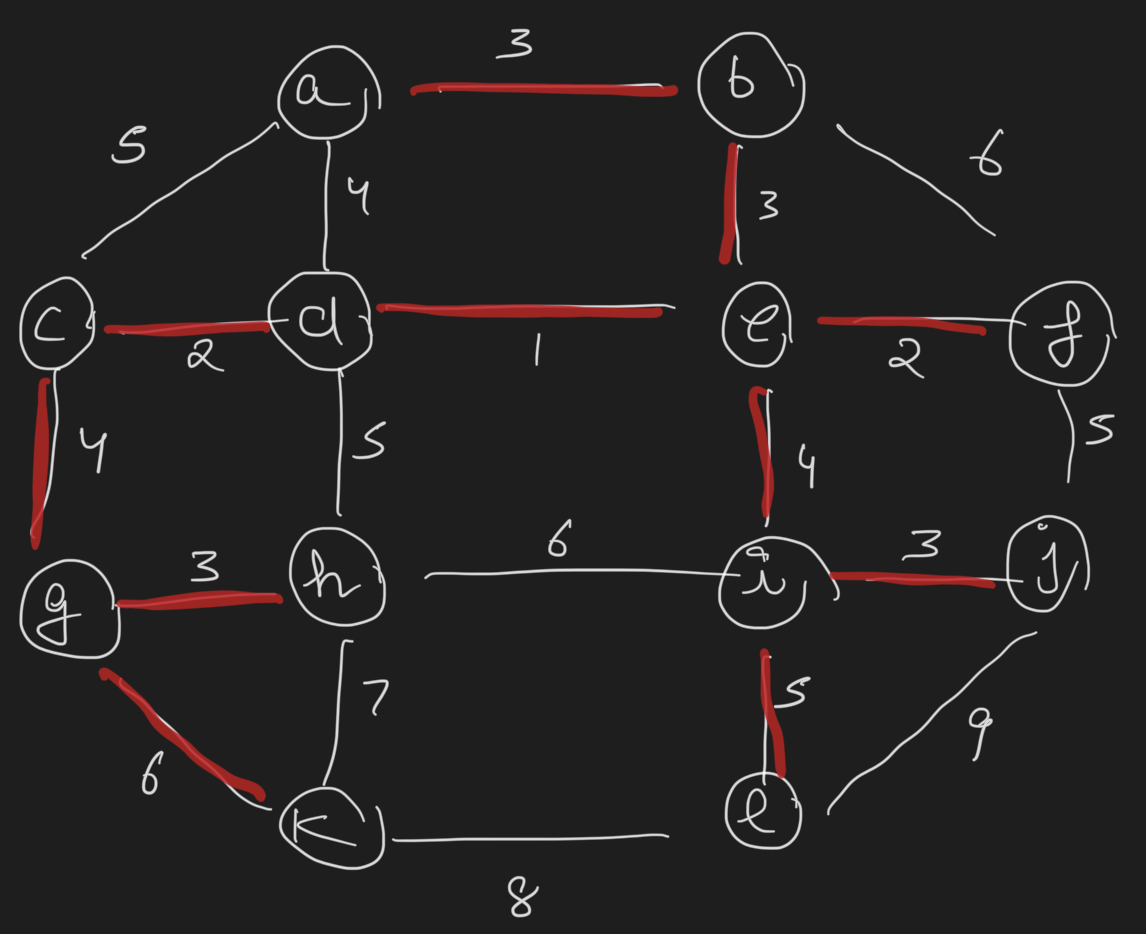
| 1 | a | b(a,5), c(a,7), d(a, ‘inf’), e(a,2) |
| 2 | e(a,2) | b(e,3), c(e,4), d(e,5) |
| 3 | b(e,3) | c(e,4), d(e,5) |
| 4 | c(e,4) | d(c,4) |
| 5 | d(c,4) | - |
Final MST Edges: (a,e), (e,b), (e,c), (c,d)
Answer 4
Prim’s Algorithm is self-checking for connectivity:
- If it can reach all vertices → Graph is connected
- If it can’t reach all vertices (or finds infinite edge lengths) → Graph is disconnected
No need for a separate connectivity check - the algorithm tells us this automatically while building the MST!
Answer 5
Yes
Proof Perspective:
- The correctness proof never assumes weights must be positive
- It only compares weights, not their signs
Simple Transformation Method:
- Add constant C to all edge weights
- New weight = original weight + C
- Every spanning tree will increase by C(n-1)
- Because every spanning tree has exactly (n-1) edges and n = number of vertices
Answer 6
Answer 7
a
| Step | Tree Vertex (Distance) | Fringe Vertices (Distance, Via) | Shortest Path from a |
|---|---|---|---|
| 1 | a(0,) | b(’+inf’), c(’+inf’), d(a,7), e(‘inf’) | d: a->d (7) |
| 2 | d(a,7) | b(d, 9), c(d, 12), e(’+inf’) | b: a->d->b (9) |
| 3 | b(d,9) | c(d, 12), e(’+inf') | c: a->d->c (12) |
| 4 | c(d,12) | e(c, 18) | e: a->d->c->e (18) |
| 5 | e(c,18) | - | - |
b
| Step | Tree Vertex (Distance) | Fringe Vertices (Distance, Via) | Shortest Path from a |
|---|---|---|---|
| 1 | a(0,) | b(a,3), c(a,5), d(a,4) | b: a->b (3) |
| 2 | b(a,3) | c(a, 5), d(a,4), e(b,6), f(b,9) | d: a->d (4) |
| 3 | d(a,4) | c(a, 5), e(d,5), f(a,9), h(d,9) | c: a->c (5) |
| 4 | c(a,5) | e(d,5), f(a,9), h(d,9), g(c,9) | e: a->d->e (5) |
| 5 | e(d,5) | f(e,7), h(d,9), g(c,9), i(e, 9) | f: a->d->e->f (7) |
| 6 | f(e,7) | h(d,9), g(c,9), i(e,9), j(f, 12) | h: a->d->h (9) |
| 7 | h(d,9) | g(c,9), i(e,9), j(f,12), k(h,16) | g: a->c->g (9) |
| 8 | g(c,9) | i(e,9), j(f,12), k(g,15) | i: a->d->e->i (9) |
| 9 | i(e, 9) | j(12,f), k(g,15), l(i,14) | j: a->d->e->f->j (12) |
| 10 | j(f,12) | k(g,15), l(i, 14) | l: a->d->e->i->l (14) |
| 11 | l(i,14) | k(15,g) | k: a->c->g->k (15) |
| 12 | k(g,15) | - | - |
Answer 8
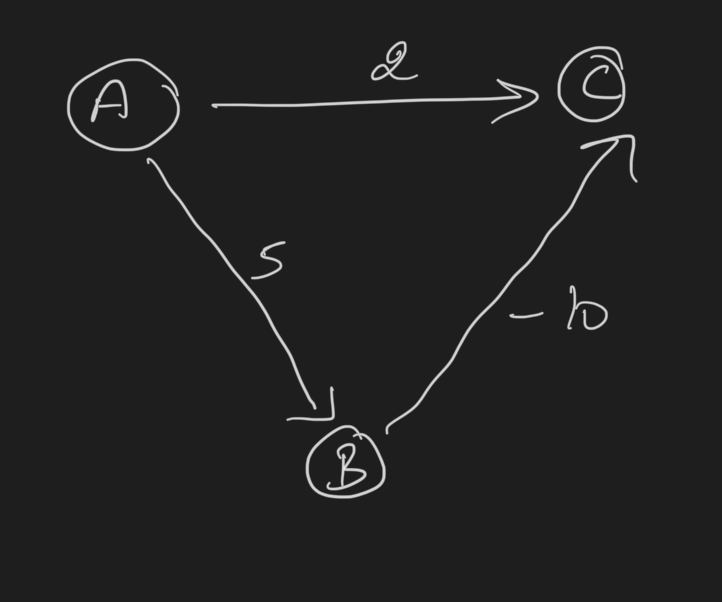
Dijkstra’s algorithm normally wouldn’t consider the path A→B→C because:
- Direct path to C doesn’t exist
- Path through B looks longer initially (5)
But actually A→B→C gives us:
- A to B: 5
- B to C: -10
- Total: 5 + (-10) = -5
Answer 9
a
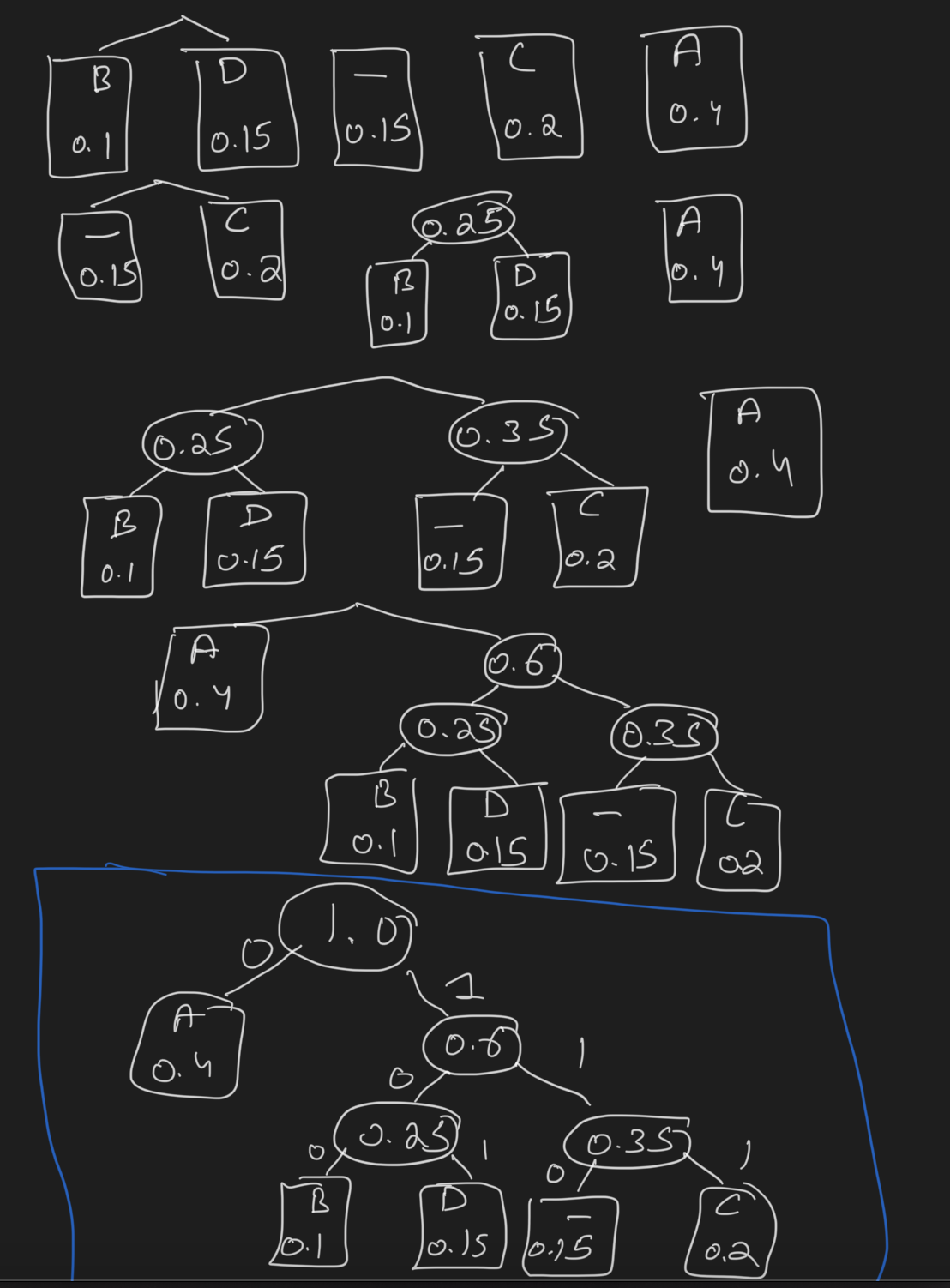
| Letter | A | B | C | D | _ |
|---|---|---|---|---|---|
| Prob. | 0.4 | 0.1 | 0.2 | 0.15 | 0.15 |
| Code-word | 0 | 100 | 111 | 101 | 110 |
b
0100011101000101
c
'100'|'0'|'101'|'110'|'0'|'101'|'0'
B      A    D     _    A    D    A
Answer 10
a
True
They are always placed as sibling nodes at the same level in the Huffman tree, resulting in identical codeword lengths
b
True
A symbol that appears more frequently will always have a codeword length that is shorter than or equal to the code-word length of a less frequent symbol.