Answer 1
a
We can sort the array first (using merge or quick sort. This takes O(nlog(n)) time). Initialize the min_distance to some infinite value and then iterate through index 1 -> n-1. Compare distance between current element and previous element. If the distance is smaller than min_distance update it.
closest_num(A[0...n-1]):
    sort(A)

    min_distance = inf

    for i = (1 -> n-1):
        distance = |A[i] - A[i - 1]|

        min_distance = min(distance, min_distance)

    return min_distance
b
In bruteforce algo, efficiency is O($n^2$) because that considers n(n-1)/2 pairs of the array’s elements.
In this algo, sorting takes O(nlog(n)) time. So, overall efficiency becomes
O(nlogn) + Θ(n) = O(nlogn)
Answer 2
a
We can use sorting for this problem as following
- Sort both bill and checks array by telephone.
- Start iterating over both arrays using 2 pointers.
- If bill number == check number, move both pointers.
- If bill number < check number, bill is unpaid, add to unpaid list and increment bill pointer.
- If bill number > check number, move check pointer.
- Any remaining bill after iteration are unpaid. (Add to unpaid set).
Time complexity : O(nlogn) + O(mlogm) = O(nlogn) because n>=m
b
We don’t need to sort array here because regardless of order, we will be updating state counter.
- Initialize a dictionary for each state with count 0.
- Start iterating the student array, and increment counter for each start by 1 per iteration.
- return this dictionary.
Answer 3
1 1 1 2
2 1 1 3
1 −1 3 8

row 2 - 2/1 row 1
row 3 - 1/1 row 1
1  1  1  2
0 −1 −1 −1
0 −2  2  6

row3 - (-2/-1) row 2
1  1  1  2
0 −1 −1 −1
0  0  4  8
Using backward substitution.
x3 = 8/4              =  2

x2 = (−1 + x3)/(−1)  = −1

x1 = (2 − x3 − x2)/1  =  1
Answer 4
a
Unique solution:
System: 2x + y = 5, x - y = 1
Solution: x = 2, y = 1
b
No solution:
System: 2x + y = 4, 2x + y = 5
Result: 0 = 1 (contradiction)
c
Infinitely many solutions:
System: 2x + y = 5, 4x + 2y = 10
Result: y = 5 - 2x, where x is any real number
Answer 5
Only (a) is valid AVL trees others are violating properties of AVL tree/ binary tree.
Answer 6
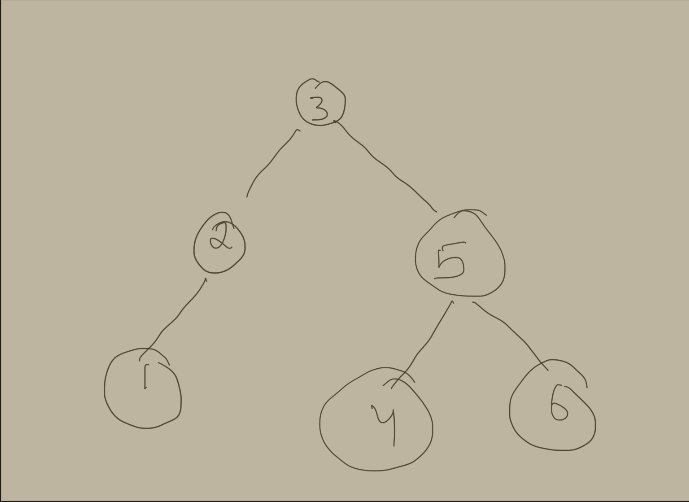
Answer 7
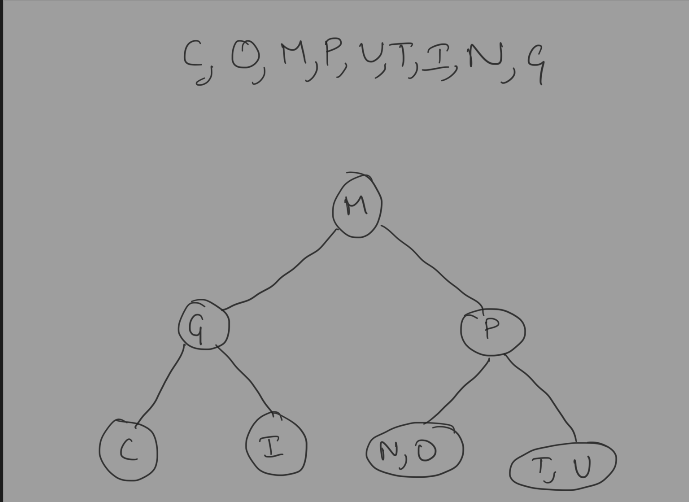
Answer 8
a
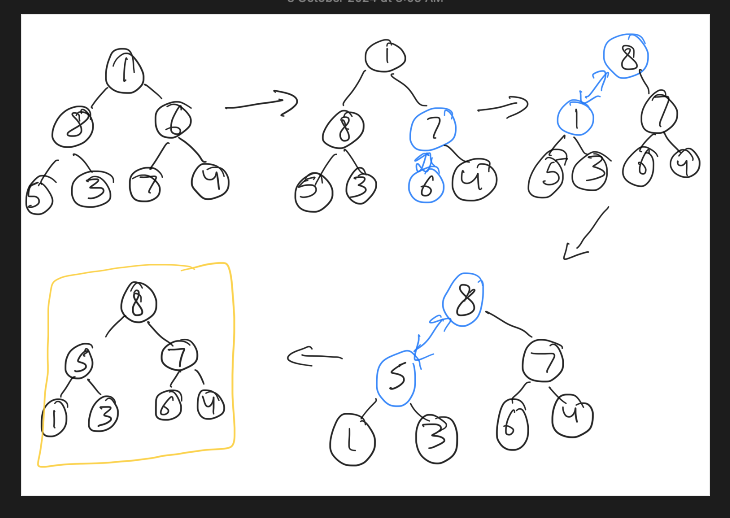
b
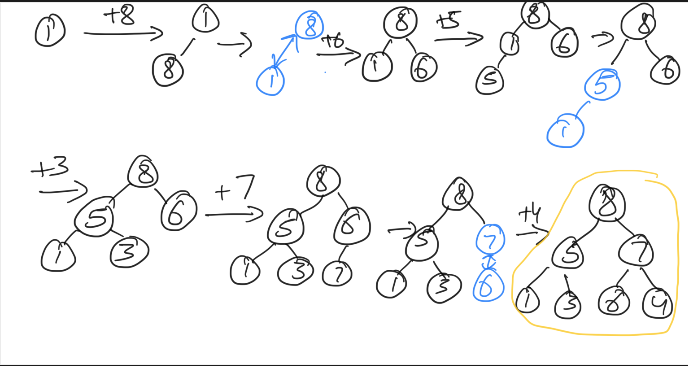
c
No, It is not necessary that heap by both the algos is same.
Answer 9
Constructed Heap (in array representation).
Heap = [T S R O I N G]
Order Of Deletion and re-structuring
T S R O I N G // Deleted
G S R O I N // T
S O R G I N
N O R G I // S,T
R O N G I
I O N G // R,S,T
O I N G
G I N // O,R,S,T
N I G
G I // N,O,R,S,T
I G
G //I,N,O,R,S,T
G
Sorted Order G,I,N,O,R,S,T
Answer 10
No, heap sort is not stable. Positions can be interchanged for same values.